Mediterranean water jars
The traditional water jars from the Mediterranean countries are a distinctive element of the tangible and intangible heritage of the Mediterranean region. These ceramic jars used to transport and store the valuable resource of water, an indispensable household utensil, from the antiquity up until the mid-20th century AD. Post-war, the water jars lost their utilitarian role and became a souvenir. The variations in terms of forms and decoration, defined the different styles from country to country, from subregion to subregion. Apart from their obvious importance for drinking water, there are several reasons that made the water jars the emblematic object of Greek and the Mediterranean ceramics…
HYDRIA participated as a virtual museum in the CreDiT “ Creative Digital Waters” Project co-funded by the EU through the Creative Europe Programme (101100365 — CreDiT — CREA-CULT-2022-COOP) that run from February 2023 until the end of January 2025, aiming to promote the oureach, awareness raising and education activities of European museums dealing with the natural and cultural, tangible and intangible water heritage and to improve people’s access to and interpretation of water heritages inside and outside museums.
Apart from HYDRIA of MIO-ECSDE two more museums participated: Aquatika in Karlovac (Croatia) and Opificio delle Acque in Bologna (Italy) together with DocServizi (coordinator) and WAMUNET. Throughout the two years life-span of the project, the partners were trained in technologies and tools for digitalization of water culture and they, in turn, shared knowledge and tools in workshops engaging high/college school students and educators.
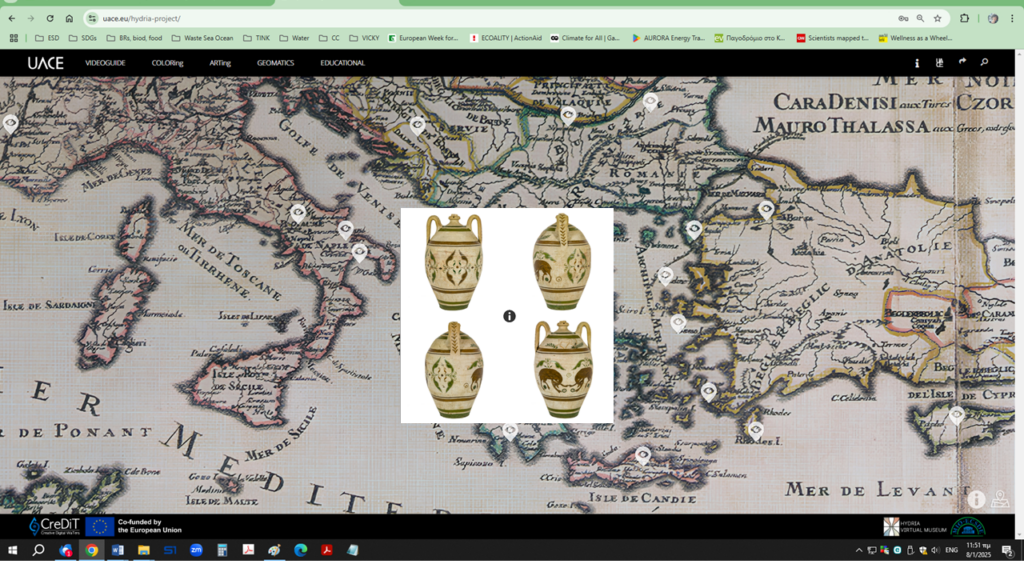
Through CreDiT Project HYDRIA created a new digital collection (uploaded on UACE platform) dedicated to traditional water jars from Greece and the Mediterranean. This section includes an interactive map with texts and high-quality images of the jars, arting and coloring sections to boost inspiration and creativity of younger and older visitors and and a unique section featuring 3D models of selected jars. The information about the description of the selected vessels was collected from the bibliography and the previous owners of the items. However, similarities as well as small variations between the jars of different origin and crafting period are quite many so that other interpretations may not be excluded.
Enjoy the digital collection at this link in English and Greek.


However, the views and opinions expressed are solely those of the author(s) and do not necessarily reflect those of the European Union or the EACEA. Neither the European Union nor the granting authority can be held responsible.